
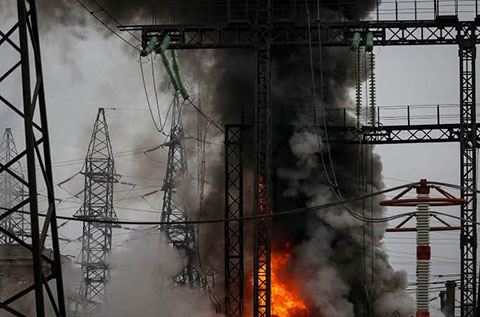
Since the summer of 2025, motorists across Russia have grown used to a sight the Kremlin spent years trying to prevent: long queues at the petrol pump. Ukraine’s escalating campaign of long-range drone and missile strikes against oil refineries, storage depots, pipelines and export terminals has produced Russia’s worst fuel crisis in decades. By July 2026, fuel-sale restrictions of one kind or another were in force across the large majority of Russia’s regions, and tens of millions of people had felt the effects directly.
The fuel crisis is, on its own, a serious economic and political problem for Moscow. But a harder question is could a crisis that began at the gas pump eventually reach the electricity socket?
The scale of Ukraine’s strike campaign has grown sharply. Attacks that were sporadic and largely symbolic in the first years of the full-scale war became, from late 2025 onward, a sustained and coordinated effort aimed at Russia’s refining sector, particularly the fluid catalytic cracking units that are the technical heart of a refinery and are notoriously difficult and slow to replace.
. . . .
period / scale of strikes / refining capacity destroyed
2022-2023 / fewer than 20 hits marginal
August-October 2025 peak / Up to 14 refineries targeted in a single month / Roughly 20% of capacity offline at the height of strikes
January-July 2026 / 194 strikes on refineries, an 11-fold rise year on year / 25% to 40% of capacity destroyed
June-July 2026 / Record 16 successful strikes in a single month; Omsk and Saratov refineries halted / Oil output down to about 4.1 million barrels a day, roughly 28% below the five-year average
. . . .
Fuel shortages had been reported in 78 of Russia’s 83 federal regions, with mandatory sales restrictions imposed in 38 of them. The number of people directly affected at roughly 50 million, more than a third of the population. Crimea, heavily dependent on road and sea supply lines that run close to the front, declared a state of emergency and banned fuel sales outright. Even Tatarstan and Bashkortostan, home to some of Russia’s largest and most modern refineries, have introduced rationing after direct strikes on flagship plants such as Tatneft’s Taneco refinery in Nizhnekamsk.
Moscow has responded with the tools available to a wartime, sanctioned economy: extending and widening bans on gasoline and diesel exports, importing several hundred thousand tonnes of petrol a month from India and other countries, leaning on Belarus, and maintaining a costly domestic price-subsidy system that has kept pump prices rising far more slowly than overall inflation. Putin has publicly acknowledged the shortages while insisting they are not “critical,” and has directed that refinery repairs be accelerated even as air-defense production is prioritized above civilian energy needs.
It would be a mistake to assume that a shortage of gasoline and diesel automatically implies a shortage of electricity. The two systems are related but not identical, and understanding the difference is the key to assessing the real risk. Russia’s electricity is generated overwhelmingly by natural gas piped directly from the field, by nuclear fission, by hydropower, and by coal hauled in by rail – not by the refined petroleum products, mainly gasoline and diesel, that are in short supply at the pump.
. . . .
source / share of generation / primary fuel input
Natural gas (thermal) / ~44-46% / Pipeline gas, not refined fuel
Nuclear / ~19% / Enriched uranium
Hydropower / ~17-18% / Water flow, seasonal
Coal (thermal) / ~15-18% / Rail-hauled coal, needs diesel-powered logistics
Fuel oil, diesel and other / ~1-3% / Direct refined-product input; larger role in isolated regional grids
. . . .
This is the central reason why, as of mid-2026, Russia has not experienced anything resembling the rolling blackouts that Russian missile and drone strikes have repeatedly inflicted on Ukraine’s grid. Ukraine’ power system has lost as much as two-thirds of its generation capacity at various points in the war because it has been directly and deliberately targeted; Russia’s has not been targeted in the same way, and its dominant fuel sources – gas, nuclear, hydro and coal – are largely insulated from a refined-fuel shortage.
That insulation, however, is partial rather than complete. There are several distinct channels through which a deepening fuel crisis can still translate into electricity stress, and it is worth examining each in turn.
Not all of Russia is connected to the Unified Energy System, the synchronous grid that links most of the country’s power plants across ten time zones. Large parts of the Russian Far East, the Arctic north and some island and peninsular territories run on isolated local grids that rely heavily on diesel generation, precisely because building gas pipelines or transmission lines to remote, sparsely populated areas is not economical. Communities in these zones already pay some of the highest electricity costs in the country and have historically experienced periodic deficits.
A sustained diesel shortage does not need to touch Moscow’s gas-fired plants to cause blackouts in Kamchatka, Chukotka, Sakhalin or the northern Kuril Islands – it only needs to interrupt the tanker and barge deliveries these communities depend on. Reports in June and July 2026 of “preventive” fuel rationing on the Kuril Islands, driven by panic-buying rather than an actual supply gap, illustrate how thin the margin already is in these regions.
Ukraine’s strike list has not been limited to oil refineries. In late June 2026, Ukrainian forces struck the Orenburg gas processing plant, a facility with a rated capacity of 45 billion cubic metres of natural gas a year, deep in the southern Urals and roughly 750 miles beyond the front line. Gas processing plants sit at the intersection of the oil and gas value chains, stripping out liquids and impurities before gas is sent onward, in some cases to power stations. As Ukraine’s target list extends further from the front and further up the supply chain, the previously sharp distinction between “the oil crisis” and “the gas-fired power sector” is becoming blurrier.
Coal-fired plants supply somewhere between 15 and 18 percent of Russia’s electricity and play an outsized role in Siberia and the Far East, where rail links to the gas network are limited. Coal does not run on gasoline, but the trucks, locomotives and heavy machinery that mine, haul and deliver it, and the maintenance crews that keep transmission lines and substations running, generally do.
A protracted diesel shortage raises the cost and slows the pace of exactly the logistics that keep thermal power plants supplied and the grid in repair. The same is true of the equipment needed to fix storm or strike damage to substations: repair convoys need fuel to reach remote sites, particularly in a country where a single interconnected grid spans over three million kilometres of power lines.
Russia’s military logistics are being shielded from the fuel crisis and will continue to be prioritized over civilian needs if a hard choice has to be made. That prioritization strategy works as intended for as long as the military and civilian fuel pools are separable. But it also means that, should the crisis deepen further, civilian infrastructure – including the diesel and technical fuel used in grid maintenance and backup generation – sits at the back of the queue, absorbing the shortage first.
Fuel shortages are already pushing up transport costs, consumer prices and business costs, and Russia’s central bank has acknowledged that months of reduced refining activity will weigh on 2026 GDP growth, which it forecasts at only 0.5 to 1.5 percent. A slowing, more inflation-squeezed economy under sustained sanctions has less capacity to fund the modernization the power sector badly needs: Russia’s generation fleet is aging, and its own Energy Strategy documents call for major new investment in thermal plant modernization and grid expansion. A macroeconomic squeeze driven by the fuel crisis makes it harder, not easier, to keep that investment on schedule, compounding reliability risk over a multi-year horizon rather than triggering an immediate blackout.
Because Russia’s core Unified Energy System is not directly fuel-oil dependent, the near-term electricity risk is not evenly spread across the country – it clusters instead around several distinct flashpoints.
Occupied and annexed Ukrainian territory, especially Crimea, where fuel supply lines run through a narrow, repeatedly targeted land corridor and local grids are smaller and more fragile. The Russian Far East and Arctic north, where isolated, diesel-heavy grids already operate with minimal reserve margins. Border and near-front regions such as Belgorod, Kursk and Krasnodar, where both energy infrastructure and transport routes are within range of Ukrainian strikes. Kaliningrad, an exclave dependent on a limited number of external supply and interconnection routes.
Away from these areas, the 80 percent of Russians who live in the western part of the country, served by the interconnected gas- and nuclear-heavy core of the grid, are considerably better insulated – for now.
Timing matters. Roughly 60 percent of Russia’s thermal generation comes from combined heat-and-power plants that supply both electricity and district heating, meaning that Russian winters place simultaneous, compounding demand on the same fuel and generation infrastructure that the fuel crisis is straining.
Shortages are likely to grow somewhat worse each summer and last somewhat longer as Ukrainian strike capacity and precision improve faster than Russian repair crews can work through backlogged damage. If that trend holds, the more dangerous test for the electricity system may not be this summer’s fuel queues but the cold months of late 2026 and early 2027, when heating and power demand both peak and diesel is needed simultaneously for generation, transport and emergency repairs.
Russia’s own campaign against Ukraine’s power system offers an instructive, if imperfect, comparison. Repeated, deliberate Russian missile and drone strikes on Ukrainian generation and distribution infrastructure have at times knocked out as much as two-thirds of the country’s power generation capacity, forcing rolling blackouts and emergency heating-season rationing across major cities.
The comparison is imperfect because Ukraine’s grid has been the direct object of a sustained strategic bombing campaign, whereas Russia’s has so far been an indirect casualty of a campaign aimed primarily at oil exports and war financing. But the Ukrainian case demonstrates how quickly an energy system can cascade from isolated disruptions into synchronized, system-wide failure once damage accumulates faster than repair capacity – a dynamic Russian planners are surely watching closely.
Moscow’s near-term responses to the fuel crisis – export bans, import scrambles and subsidized pricing – buy time but do not address the underlying capacity loss, and each carries its own cost. Fuel subsidies alone cost the Russian government an estimated 2.6 trillion rubles, or about $35 billion, in 2025, roughly half of the federal budget deficit. Allowing prices to rise toward market levels would reduce demand and encourage more imports, but at a politically painful cost in inflation and public discontent that the Kremlin has so far chosen to avoid.
Meanwhile, officials such as Deputy Prime Minister Alexander Novak have floated tightening restrictions further, including a full ban on diesel exports, which would help domestic diesel availability for the grid and agriculture but would cut into the export revenue Russia depends on to fund the war and, indirectly, energy-sector investment.
Longer term, Rosneft and other oil majors face a genuine repair bottleneck: it would take four to six months to restore lost refining capacity even if Ukrainian strikes stopped entirely tomorrow, and there is no sign of that happening. Sanctions have also complicated Russia’s access to the specialized parts, catalysts and technical expertise refineries need for those repairs, extending timelines further.
The top Russian officials describe the current fuel situation in Russia as “manageable” for the country as a whole, even while acknowledging that shortages are on a worsening long-term trend and that acute local crises, especially near the front, are a legitimate concern.
At the same time, the corrosive political and psychological effect can be emphasized. The fuel rationing is bringing the war home to Russians in major cities in a way that four years of front-line news coverage did not. The disruption as attritional and corrosive to the government’s legitimacy rather than an immediate threat to political stability.
Russia’s core power grid is not fuel-oil dependent and has considerable structural resilience, drawing on nuclear, hydro and pipeline gas that Ukrainian strikes have mostly left alone. But there is a rising risk at the margins – isolated regional grids, occupied territories, aging thermal infrastructure and a widening overlap between Ukraine’s target list and Russia’s gas-processing and power-adjacent infrastructure – as the trend to watch.
As of July 2026, Russia has a severe, worsening and politically significant fuel crisis, but not an electricity crisis. The two systems are more separable than casual intuition suggests, and the core of Russia’s power grid – nuclear, hydro and gas piped directly from the field – has so far proven far more resilient than the refining sector that supplies gasoline and diesel to Russian drivers and businesses.
Yet the boundary between the two crises is not fixed. Diesel-dependent isolated grids in the Far East and occupied territories, an expanding Ukrainian target list that increasingly touches gas-processing infrastructure, the diesel dependency of coal logistics and grid-repair crews, wartime prioritization that pushes civilian needs to the back of the fuel queue, and a slowing, sanctioned economy with less capacity to fund overdue grid investment are all channels through which today’s fuel shortage could feed tomorrow’s power shortage.
Each on its own is manageable. Compounded during a hard winter, or accelerated by a further escalation in Ukrainian strikes on gas and power infrastructure, they could plausibly combine into the kind of cascading grid stress that Ukraine itself has experienced for the past several winters. For now, that remains a risk anyway as the war moving toward cold months.
By Rafael Lagard
© Times of Ukraine